Your state department of insurance keeps the list of agents and companies licensed in your state (NAIC), and the Utah Insurance Department says to check an agent's license status for the product being sold before you decide (both as of November 26, 2026). California's department says its lookup shows the license status and discipline history.
Key facts: The NAIC says your state department of insurance provides a list of agents and companies licensed to do business in your state (NAIC consumer guide, as of November 26, 2026). · The Utah Insurance Department says to verify, with the state's licensee search, that an agent holds a license for the product they are selling. · The NAIC says to make the check payable to the company, not the agent, and not to sign an application until you have reviewed it carefully.
Let's face it: handing your family's financial safety net to a stranger because they have a friendly voice and a laminated business card is how bad stories start. The good news is that checking an agent takes about two minutes and costs nothing. This post walks through where agents come from, how to verify one, and what to confirm before you pay anything. It is general education, not advice about what to buy.
Where Do Agents Come From? (Not the Stork, Sadly)
The Utah Insurance Department's Finding an Agent page lists a few starting points: call a company directly, check a company's website (many have an agent locator), or contact an agent association. The NAIC, the group of state insurance regulators, also has a directory with a "Find an Insurance Agent" tool by state.
Utah's page also explains four ways insurance gets sold:
- Captive agent: represents a single insurer, or one fleet of insurers (one menu, many waiters).
- Independent agent: works with more than one company.
- Broker: an independent salesperson who, in Utah's wording, searches the marketplace in the interests of clients and may place coverage with any admitted insurer.
- Direct writer: a company's own employees selling directly, usually by mail or phone.
Which one suits you is a personal call. The point is that "agent" is a category, not a guarantee of anything, which brings us to the license.
The Two-Minute License Check (Cheaper Than Therapy)
The NAIC says your state department of insurance provides a list of agents and companies licensed to do business in your state. That list is your source of truth, not the agent's website and not the logo on the pamphlet.
Here is how that looks in practice:
- Find your state's lookup. Start at the NAIC directory above and pick your state, or search "[your state] department of insurance license lookup."
- Search by name or license number. California says its Check a License tool retrieves the license status and discipline history of an agent, broker or business using either one.
- Confirm it is current. Utah says its Licensee Search is for verifying that a specific agent or agency is currently licensed in Utah.
- Confirm it covers what you are buying. Utah says to check the license for the product the agent is selling.
- Read the record. If the tool shows discipline history, read it. A clean record is not a promise, and a long one is information.
Utah and California are the examples we sourced here. Use your own state's department, since the NAIC says the list that matters is of agents licensed to do business in your state.
The Fine Print: A valid license shows an agent is allowed to sell insurance in your state. It does not show the policy is the right fit or the right price for you. The Utah Insurance Department notes that licensing needs to match the product being sold, and the NAIC reminds buyers to review the application carefully before signing. Check the license, then still read the policy.
Before You Sign or Pay (The Paperwork Part, Sorry)
The NAIC's buying tips are short and practical:
- Make sure you feel confident in the agent and the company.
- Decide how much you need, for how long, and what you can afford.
- Do not sign an application until you have reviewed it carefully to be sure it is complete and accurate.
- When you buy a policy, make the check payable to the company, not the agent.
The Utah Insurance Department's 10 things to know adds a few more worth stealing:
- Tell the truth on the application. Insurers check your answers, and false statements could reduce or cancel coverage.
- Do not cancel your current policy until the new one arrives. Utah also says replacing a policy may be costly, so study both before swapping.
- Ask for a year-to-year display of values and benefits if the policy builds cash value, and ask what part of the premiums or benefits is not guaranteed.
Will an Agent Make It Cost More? (Spoiler: Probably Not)
A common worry is that using an agent adds a surcharge. The NAIC says you will likely pay the same premiums if you use an agent or purchase a policy online, and that an agent can help you work out how much insurance you need, understand the terms and complete the application. How an agent is paid is a fair question to ask directly, and we have not sourced specific pay arrangements here.
The Bottom Line (Short, Like Your Patience for Paperwork)
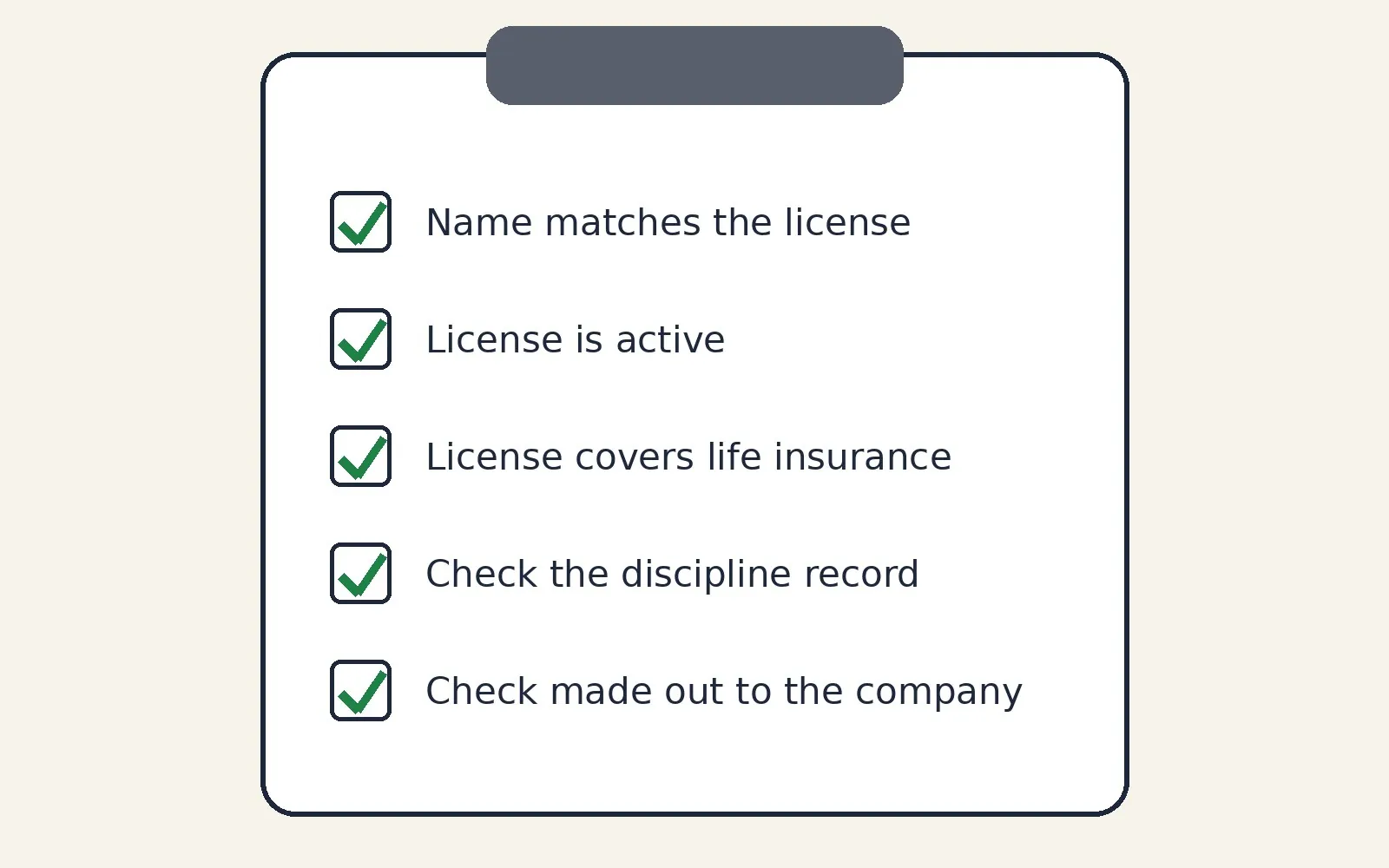
Find the agent however you like, then verify the license with your state insurance department, make sure it covers life insurance, read any discipline history, and pay the company rather than the person. Then go brag about being the one person who actually did the homework.
Want to talk it through with a licensed agent? Email Operations@PowerFinancial.co.
This article is general education, not tax, legal or insurance advice. Talk to a licensed professional about your own situation. Rules differ by state.
Sources:
- NAIC, Life insurance consumer guide
- NAIC, State insurance departments and agent directory
- Utah Insurance Department, Finding an Agent
- Utah Insurance Department, Licensee Search
- Utah Insurance Department, Life insurance: 10 things to know
- California Department of Insurance, Check a License
Frequently asked questions
How do I check if a life insurance agent is licensed?
Use the lookup tool on your own state insurance department's website. Utah's department, for example, offers a Licensee Search to verify that a specific agent is currently licensed in Utah, and California's Check a License tool retrieves license status and discipline history by name or license number. The NAIC keeps a directory that links to every state department.
Do I pay more if I buy through an agent?
Not necessarily. The NAIC says you will likely pay the same premiums whether you use an agent or buy a policy online, and that an agent can help you work out how much insurance you need and understand the policy terms.
Who should the premium check be made out to?
The NAIC says to make the check payable to the company, not the agent.
What if I have a problem with an agent?
The NAIC's state department directory includes a place to file a complaint about an insurance company or agent with your state insurance department.